How to Heat and Cool a Sunroom in South Louisiana
Plan for cooling first. Baton Rouge logs about 2,818 cooling degree days a year and 1,534 heating degree days, per NOAA’s 1991 to 2020 climate normals. Start with glass that blocks solar heat, add ceiling fans, then size a heating and cooling unit to the room.
TLDR:
- In Baton Rouge, the cooling season is the hard part. Heating is the easier half.
- The glass does more work than the unit. Low solar heat gain glass keeps the load down from the start.
- Ceiling fans cool people, not rooms, so they pair with a unit instead of replacing one.
- A ductless mini-split heat pump is a common fit for a room with no ductwork, because it heats and cools.
- Size any unit with a Manual J load calculation. A rule-of-thumb chart is only a starting point for a glass room.
- An oversized unit cools fast but leaves the room damp, which matters in our humidity.
- Plan the wiring before the walls close up, so the outlet and circuit are where the unit needs them.
A sunroom in the Greater Baton Rouge area gets judged in August. Glass lets in the light you want, and it lets in the sun’s heat with it. A room that is only planned for cold snaps can turn into a greenhouse by June. The good news is that a few decisions made at the design stage handle most of the problem.
Planning a sunroom you can use in July and January? We measure your space, talk through glass and framing, and plan the wiring for fans, lights, and heating and cooling before anything is built.
Why a Louisiana Sunroom Is a Cooling Problem First
Most heating and cooling advice for sunrooms is written for cold climates. Around Baton Rouge, the numbers point the other way.
According to NOAA’s monthly normals for Baton Rouge Ryan Airport, the normal daily high reaches 92.2°F in August. The coldest normal low is 41.6°F in January. The same 1991 to 2020 data counts 96.4 days a year at or above 90°F, and 18.4 nights at or below freezing.
Cooling degree days measure how much cooling a climate calls for, and heating degree days measure the same for heat. Here, cooling outweighs heating by almost two to one. So the heating plan for a sunroom can stay simple, and the cooling plan needs real thought.
Start With the Glass, Not the Air Conditioner
The cheapest heat to remove is the heat that never gets in. In a sunroom, most of the summer load comes through the glass.
Windows carry a rating called the solar heat gain coefficient, or SHGC. The lower the number, the smaller the share of the sun’s heat that gets through.
The ENERGY STAR criteria for residential windows call for an SHGC of 0.23 or lower in both the South-Central and Southern climate zones, the two zones that cover Louisiana. They also set a U-factor of 0.28 or lower in the South-Central zone and 0.32 or lower in the Southern zone.

Every sunroom we build gets energy-efficient glass and insulated framing, as our custom sunroom builds page lays out. When you compare quotes, ask for the SHGC and U-factor of the glass in writing. Those two numbers shape how hard any unit has to work later.
Ceiling Fans: Comfort, Not Cooling
A ceiling fan is the first thing most people add to a sunroom, and it earns its place. It just does a different job than an air conditioner.
ENERGY STAR’s 2026 ceiling fan usage tips put it plainly: “Ceiling fans cool people, not rooms.” The same guide says to run the fan counterclockwise in summer. In winter, it says to reverse the motor and run the fan on low, clockwise, which moves warm air down from the ceiling.
So a fan makes a warm room feel better while you are in it, but it does not lower the temperature. Turn it off when the room is empty. In a glass room that sits in full sun, a fan works best as a partner to a cooling unit, not a substitute for one.
The Options for Heating and Cooling a Sunroom
Once the glass and fans are settled, the question is what actually conditions the air. There are five common answers, and they are not equal.
Extending the House Ductwork
Running a duct off the home’s system looks simple on paper. The catch is capacity. Your existing system was sized for the house as it stood, not for a new glass room on the back of it.
ENERGY STAR’s 2026 guide to ductless heating and cooling names “additions or outbuildings” where “extending ductwork or heating/cooling capacity is difficult” as a fit for ductless systems instead. Ask an HVAC contractor to check the numbers before you count on the ducts.
Ductless Mini-Split Heat Pumps
A mini-split puts an indoor unit on the wall and an outdoor unit outside, joined by a refrigerant line. There is no ductwork, and a heat pump model both heats and cools.
The same ENERGY STAR guide describes these systems as designed for “homes or sections of homes that do not have ductwork.” For our climate, the operating range is rarely the limit. For one example, Mitsubishi Electric’s product page for its MUZ-HX single-zone outdoor unit lists heating and cooling in outdoor temperatures from -5°F up to 115°F.
That range covers every normal Baton Rouge month with room to spare. Each brand and model publishes its own range, so check the spec sheet for the unit you are quoted.
Want the wiring for a mini-split planned before your sunroom is built? We design the room, the glass, and the electrical rough-in together, so the outlet and circuit are where the unit needs them.
Through-the-Wall and Window Units
A through-the-wall or window unit can cool a smaller room, and some models add heat. It is a simpler install, though it takes up wall or window space.
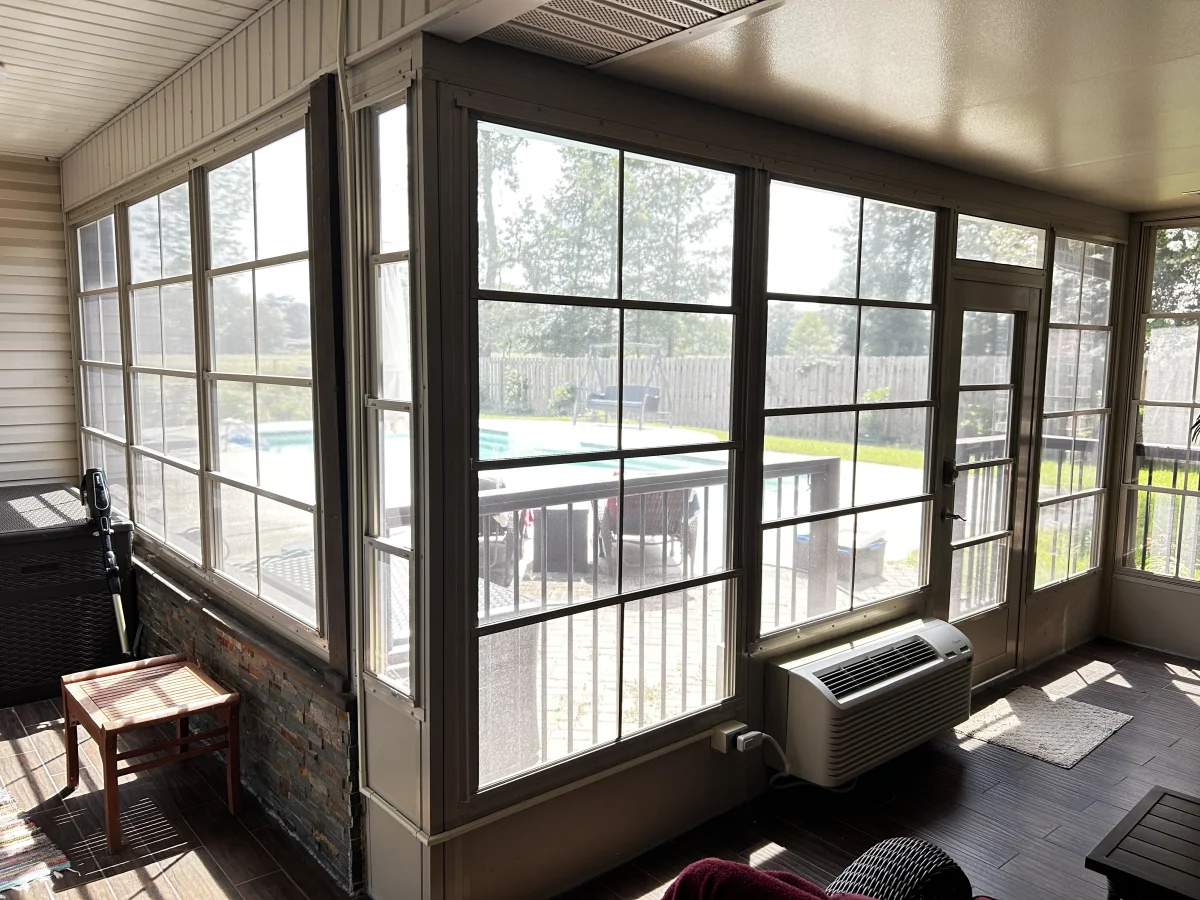
ENERGY STAR’s room air conditioner sizing chart calls for 6,000 BTU per hour for 150 to 250 square feet. It adds 10 percent if the room is very sunny.
By that math, a 12 by 16 foot sunroom (192 square feet) starts at about 6,600 BTU per hour. Treat that as a starting point. The chart is calculated on an 8-foot ceiling with one 10 percent adjustment for sun, and a room walled in glass is what a load calculation is for.
Plug-In Space Heaters
With about 18 freezing nights in a normal year, a space heater can cover the occasional cold snap. It does nothing for summer, which is the season that decides how much you use the room.
Size the Unit With a Load Calculation, Not a Guess
Getting the size right matters more in a sunroom than almost anywhere else in the house. Glass, roof, and sun exposure vary from one room to the next.
ENERGY STAR’s ductless guide says your contractor should verify the system size with a tool called Manual J. The Air Conditioning Contractors of America’s Manual J is the ANSI-recognized standard for residential load calculations. It includes procedures for window and glass loads. That is the part a sunroom has the most of.
Bigger is not safer. ENERGY STAR’s 2025 room air conditioner fact sheet warns that an oversized unit “will cool the room, but only remove some of the humidity,” leaving a “damp, clammy feeling.” In a Louisiana summer, that clammy feeling is exactly what you are trying to escape.
When you get an HVAC quote, ask which model it is and look up its certified ratings. The Air-Conditioning, Heating, and Refrigeration Institute’s certification program says its directory lets consumers “search by product lines, certified ratings, or brands.”
What About Screen Rooms and Eze-Breeze Rooms?
Not every outdoor room is built to be conditioned. Where your room sits on that range decides what heating and cooling makes sense.
A screen room is open to the air by design, so fans are the tool there, not air conditioning.
An Eze-Breeze room can switch between open and closed. The vinyl panels close against wind and rain, but it is not built as a fully conditioned addition. Our Eze-Breeze room options cover how the panels open and close, and our plain-language Eze-Breeze explainer walks through where it fits.
If true year-round comfort is the goal, a sunroom built with insulated framing and energy-efficient glass is the one designed for it. Our guide to choosing between a sunroom, screen room, and glass room lays out the trade-offs side by side.
Plan the Heating and Cooling Before the Build
The best time to decide on heating and cooling is before the walls go up. Changing the plan afterward usually means cutting into finished work.
At the design stage, settle three things. First, where the indoor unit or wall unit will go. Second, where the outdoor unit can sit. Third, what electrical the room needs. Every Tiger Town sunroom is wiring-ready for lighting, fans, and outlets, and we can wire it for heating and cooling.
Then bring your HVAC contractor’s equipment choice to the planning table. That way the circuit, the wall space, and the line path all match the unit, and nothing has to be redone. You can see how one of our finished rooms came together in this Baton Rouge sunroom addition.
Common Questions About Heating and Cooling a Louisiana Sunroom
These are the comfort questions homeowners raise before a sunroom goes up. Most of them come back to the same two ideas: cooling comes first here, and the unit should be sized to the room.
What is the best way to heat and cool a sunroom in Louisiana?
Start with glass that blocks solar heat, then add ceiling fans, then a unit sized to the room. A ductless mini-split heat pump is a common fit because it heats and cools without ductwork. Have an HVAC contractor size it with a Manual J load calculation instead of a rule of thumb.
Can I just extend my home’s AC into the sunroom?
Sometimes, but not by default. Your current system was sized for the house without the sunroom. ENERGY STAR lists additions where extending ductwork or capacity is difficult as a fit for ductless systems. Ask an HVAC contractor to run the numbers before tying a glass room into your existing ducts.
What size air conditioner does a sunroom need?
It depends on the glass, the roof, and the sun exposure. ENERGY STAR’s room AC chart calls for 6,000 BTU per hour for 150 to 250 square feet, plus 10 percent for a very sunny room. For a glass room, treat that as a starting point and have a Manual J load calculation done.
Is a bigger unit better for a hot sunroom?
No. ENERGY STAR warns that an oversized room air conditioner cools the room but removes only part of the humidity, leaving it damp and clammy. In south Louisiana’s humidity, that defeats the purpose. A right-sized unit runs longer cycles and pulls more moisture out of the air.
Do ceiling fans cool a sunroom?
They cool people, not the room. ENERGY STAR says to run them counterclockwise in summer and turn them off when no one is in the room. In winter, reversing the fan to run clockwise on low moves warm air down from the ceiling. Fans pair well with a cooling unit.
Do I need heat in a Baton Rouge sunroom?
Some, but far less than cooling. NOAA’s 1991 to 2020 normals for Baton Rouge show about 18 nights a year at or below freezing and a January normal low near 42°F. A heat pump that also cools covers both seasons with one unit.
Get a sunroom planned for August and January alike. We come out, measure, and walk you through glass, framing, and wiring for heating and cooling, with a clear, itemized quote. No pressure, and the owner is on every job.