Eze-Breeze Rooms Explained for Baton Rouge Homeowners
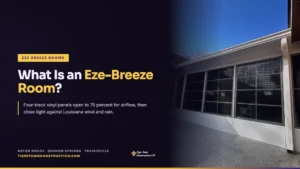
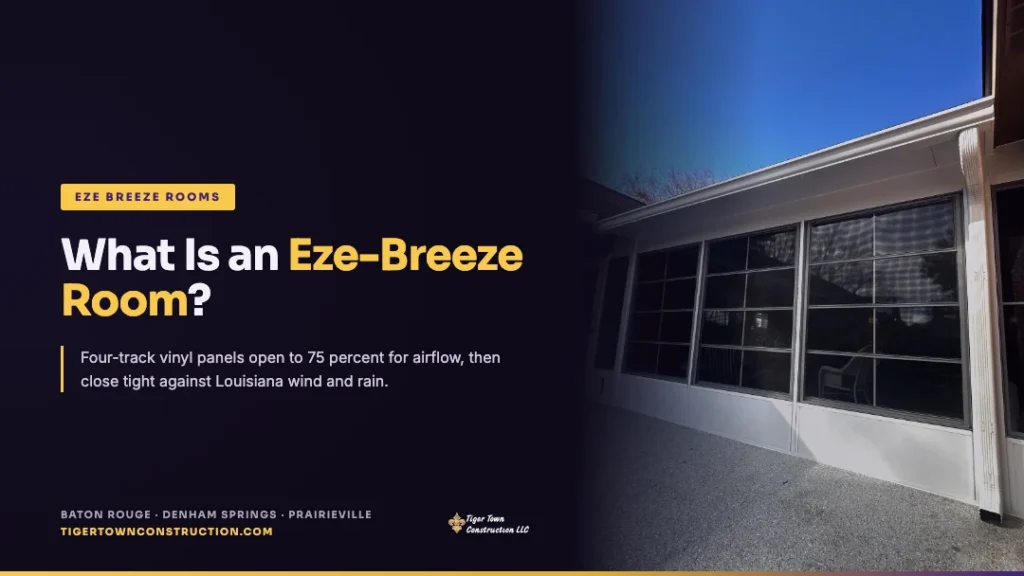
An Eze-Breeze room is a porch enclosed with four-track vinyl panels that slide and stack, opening your walls up to 75 percent for full airflow and closing tight when the weather turns. It sits between a screen room and a glass room: more protection than screen, far less cost and commitment than a conditioned sunroom.
TLDR:
- Eze-Breeze is a real product, not a style. It is a four-track vinyl panel system set into an aluminum frame.
- Panels open to 75 percent for airflow, then close against wind and rain. That is the whole point of the system.
- The vinyl blocks 99 percent of UV rays, so your furniture and flooring stop fading.
- It is not insulated and not climate controlled. It extends your season, it does not give you a year-round conditioned room.
- Panels tilt in for cleaning, and the frames carry a lifetime warranty.
- Tiger Town prices these by the square foot and quotes on site after measuring your space.
Most Louisiana porches fail for one of two reasons. Either the bugs make them unusable, or a fast-moving storm blows rain sideways across your furniture. A screen porch solves the first problem and does nothing about the second. That gap is the reason vinyl panel systems caught on here.
Not sure which enclosure fits your backyard? Tell us how you actually want to use the space, and we will give you a straight recommendation, not a sales pitch.
Call (504) 210-6398 Get My Free Quote
What Is an Eze-Breeze Room, Exactly?
The name confuses people because it sounds like a style of porch. It is not. Eze-Breeze is a manufactured window system, and a room built with it is a porch fitted with those panels.
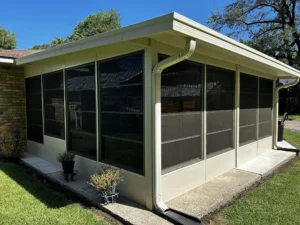
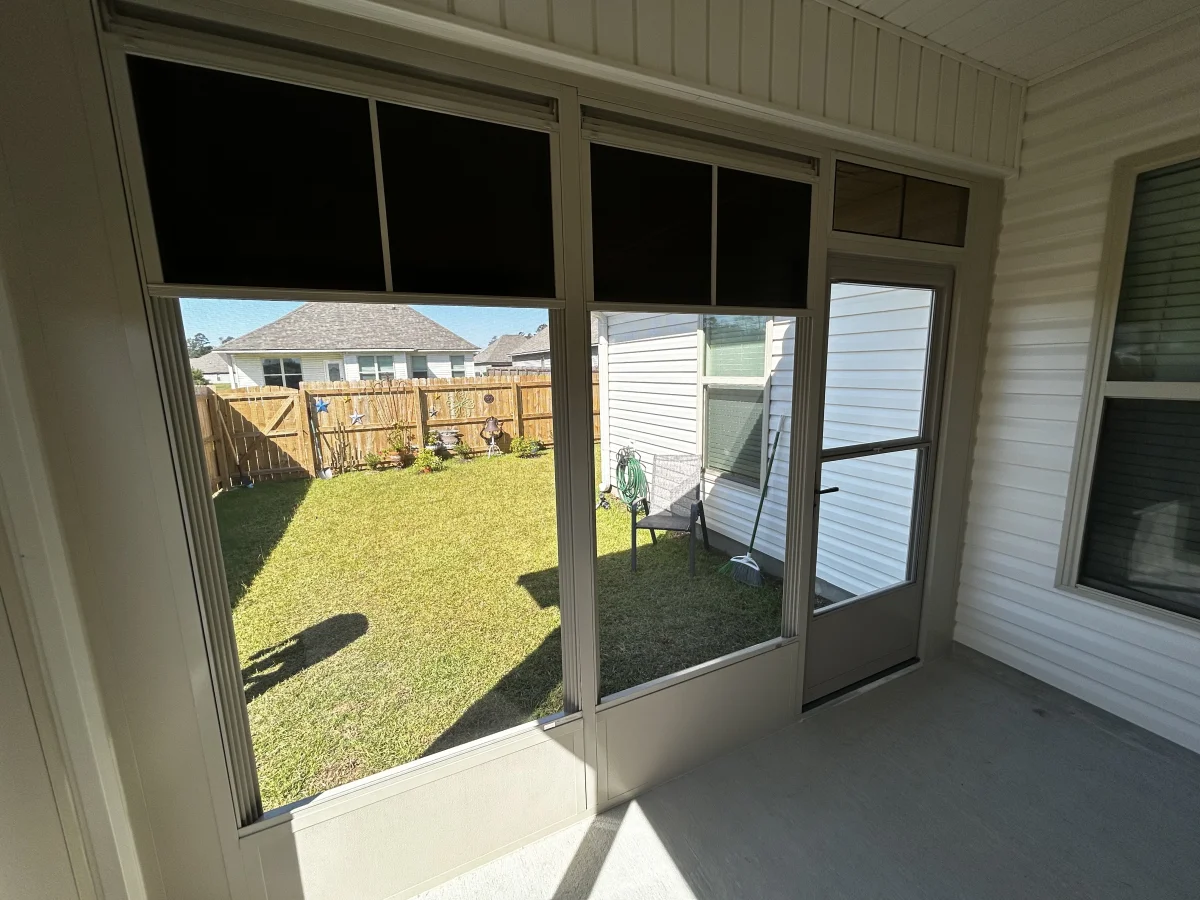
Each opening holds a set of vinyl vents mounted in an aluminum-extruded frame. The vents ride on four separate tracks, which is where the four-track name comes from. Slide them up or down, and they nest behind one another, stacking out of the way instead of swinging into your space.
According to the manufacturer’s vertical four-track specifications, the system opens to as much as 75 percent ventilation and comes in two-, three-, or four-vent configurations depending on the size of your opening. The vinyl is flexible rather than rigid, so it returns to its original shape within minutes of being pushed or struck.
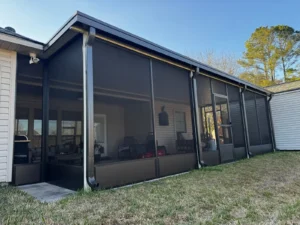
Behind the vinyl sits a screen, so opening the panels gives you a screen porch. Closing them gives you a weather barrier. One room, two modes, changed in a few seconds by hand.
How Vinyl Panels Handle Louisiana Humidity
Humidity is the reason this system reads differently here than it does in a dry climate. Airflow is not a comfort upgrade in south Louisiana. It is the entire mechanism that makes an outdoor room usable.
A sealed room with no ventilation traps warm, damp air, and that is where musty smells and mildew on cushions start. Because the Eze-Breeze vents open to three quarters of the opening, the room breathes on any day with a breeze. You are not relying on a fan to move air that has nowhere to go.
The second half is season length. The LSU AgCenter’s mosquito research describes near year-round mosquito activity across south Louisiana, with the season running roughly 10 to 12 months and peaking in July and August. A porch you can only use in the few weeks between bugs and heat is not much of a porch.
The panels also cut sun damage. The manufacturer rates the vinyl at blocking 99 percent of harmful UV rays, which is what keeps cushions, rugs, and wood flooring from going pale after two summers facing west.
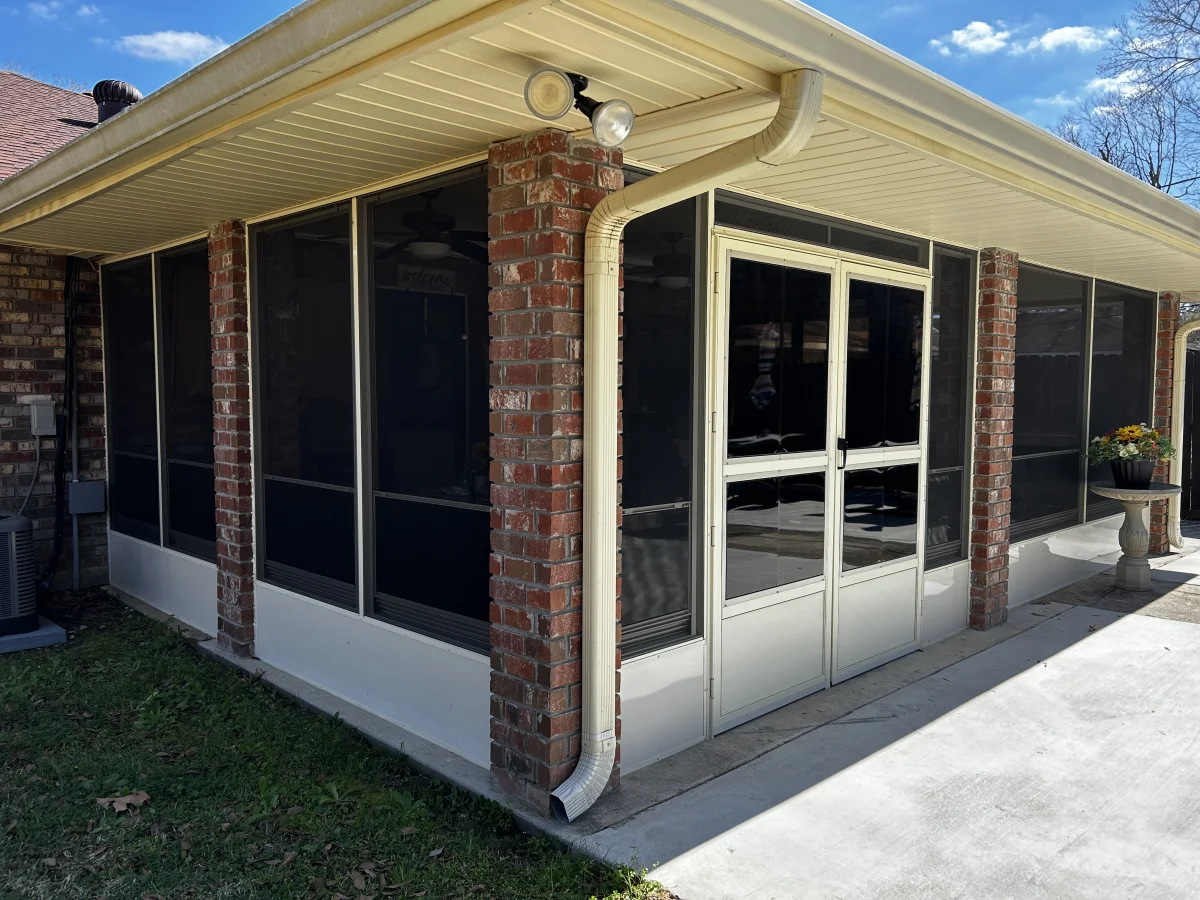
How an Eze-Breeze Room Compares to a Screen Room
A screen room and an Eze-Breeze room look similar from the driveway. They behave nothing alike once weather arrives.
Screen handles insects and nothing else. Rain passes straight through it, wind passes straight through it, and pollen mostly does too. In spring that is fine. In February, or during a squall, the room is off limits and the furniture gets wet.
Eze-Breeze gives you the screen behavior on demand and adds a closed position you simply do not have with screen. That is the practical difference: usable days. If you want the full three-way breakdown, our guide to how screen rooms, glass rooms, and sunrooms actually compare walks through each one.
Screen is still the right answer for some homeowners. If your only complaint is mosquitoes, and you have no interest in using the space in January, a traditional screen room build costs less and does that one job well.
How an Eze-Breeze Room Compares to a Glass Room or Sunroom
This is where honesty matters more than salesmanship, because the systems are not interchangeable.
A glass room or a finished sunroom is a sealed thermal envelope. It can be insulated, conditioned, and treated as real living space attached to your house. An Eze-Breeze room cannot. The vinyl is a weather barrier, not insulation, and the room is not designed to hold a temperature.
What you get instead is most of the shoulder season at a fraction of the cost and none of the HVAC work. What you give up is January comfort and the ability to call it conditioned square footage. If you want a room you will use every day of the year, a fully finished sunroom is the honest recommendation.
Already know a vinyl enclosure is the direction you want? We will measure your existing slab or patio and show you what the panels look like in your own opening.
Call (504) 210-6398 Request a Free Consultation
What an Eze-Breeze Room Costs and What Drives the Price
Every opening is a different size, so nobody can quote this off a price list. What is useful is knowing the neighborhood each option lives in.
Industry pricing collected by Angi’s 2026 screened-porch cost research puts basic porch screening in the range of 10 to 25 dollars per square foot. Their 2026 sunroom cost guide puts a three-season conversion at roughly 80 to 230 dollars per square foot and a fully conditioned four-season room at 200 to 400. A vinyl panel enclosure lands between those two, closer to the screen end than the sunroom end.
The things that actually move your number are opening size, how many vents each opening needs, the condition of the slab underneath, and how much structure has to be built before any panel goes in. A porch that already has a solid roof and slab is a much smaller project than one starting from bare concrete.
Tiger Town prices this work by the square foot and quotes on site after measuring. For a sense of how outdoor structure pricing works here generally, our breakdown of what outdoor structures run in the Baton Rouge area covers the same variables.
What Installation Looks Like Around Baton Rouge
The process is short, and most of the work happens before anything gets installed.
It starts with a free on-site quote where we measure the opening and give you itemized pricing by the square foot. From there the design gets matched to your home’s roofline, pitch, and color, because a panel enclosure that ignores the roof above it always looks added on.
Then we build. The structure is engineered to Louisiana wind and building code, and the framing is wiring-ready, so fans, lights, and outlets can go in without opening anything back up later. Frames come in white, beige, bronze, pebble khaki, and black, with vinyl in clear, smoke gray, bronze, or dark gray.
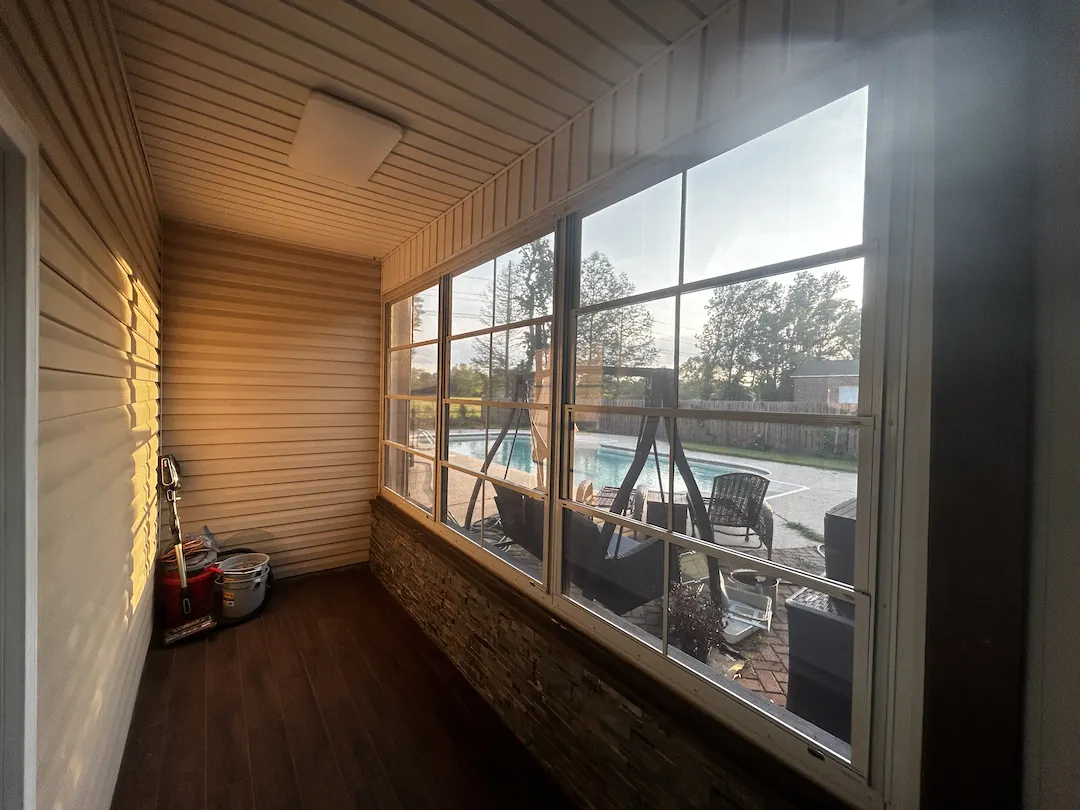
The last step is a walk-through where someone shows you how the panels actually operate. It takes two minutes, and it is the difference between using the system correctly and fighting it. You can see the full service details on our Eze-Breeze room installation page.
What Baton Rouge Homeowners Ask About Eze-Breeze Rooms
These are the questions that come up on nearly every quote we run in Denham Springs, Prairieville, and around Baton Rouge. If yours is not here, call and ask.
Can you see through Eze-Breeze vinyl clearly?
Yes, though it is not the same as glass. Clear vinyl gives you a bright, usable view that is slightly softer than a window pane. Tinted options in smoke gray, bronze, and dark gray cut glare and add privacy, at the cost of some brightness.
Do the panels keep rain out completely?
Closed panels shed normal wind-driven rain, which is what makes the room usable during a typical Louisiana storm. It is a weather barrier rather than a sealed window unit, so in an extreme sideways blow you may see a little moisture at the seams.
Do vinyl panels trap heat or humidity inside?
Only if you leave them closed on a hot day, which is not how the system is meant to be used. Opening the vents to 75 percent turns the space back into a screened porch and lets the humidity move through. The room is designed to be adjusted with the weather.
How do you clean the vinyl?
The vents tilt inward so you can reach both sides from inside the room. Mild soap and water is all it takes. Skip abrasive cleaners and ammonia-based glass sprays, since those cloud vinyl over time.
Is an Eze-Breeze room warm enough for a Baton Rouge winter?
On a mild winter day with sun, yes, and that is where most of the added value shows up. On a hard freeze, no. The panels block wind and rain, but they are not insulation, so a space heater is doing the real work if you want to sit out there in January.
Get a straight answer on your own porch. We measure the opening, show you the panel and frame colors against your house, and give you itemized pricing by the square foot. No pressure, and the owner is on the job from the first quote to the final walk-through.